Skip to content
MAYDI

Research

A distinctive frankincense chemistry. A research trail of its own.

Frankincense research often centres on boswellic acids. Maydi’s published chemistry centres on lupeol, 3-epi-lupeol, α-amyrin, β-amyrin and a characteristic volatile profile including α-pinene and α-thujene. That distinctive profile gives Boswellia frereana a research trail of its own.

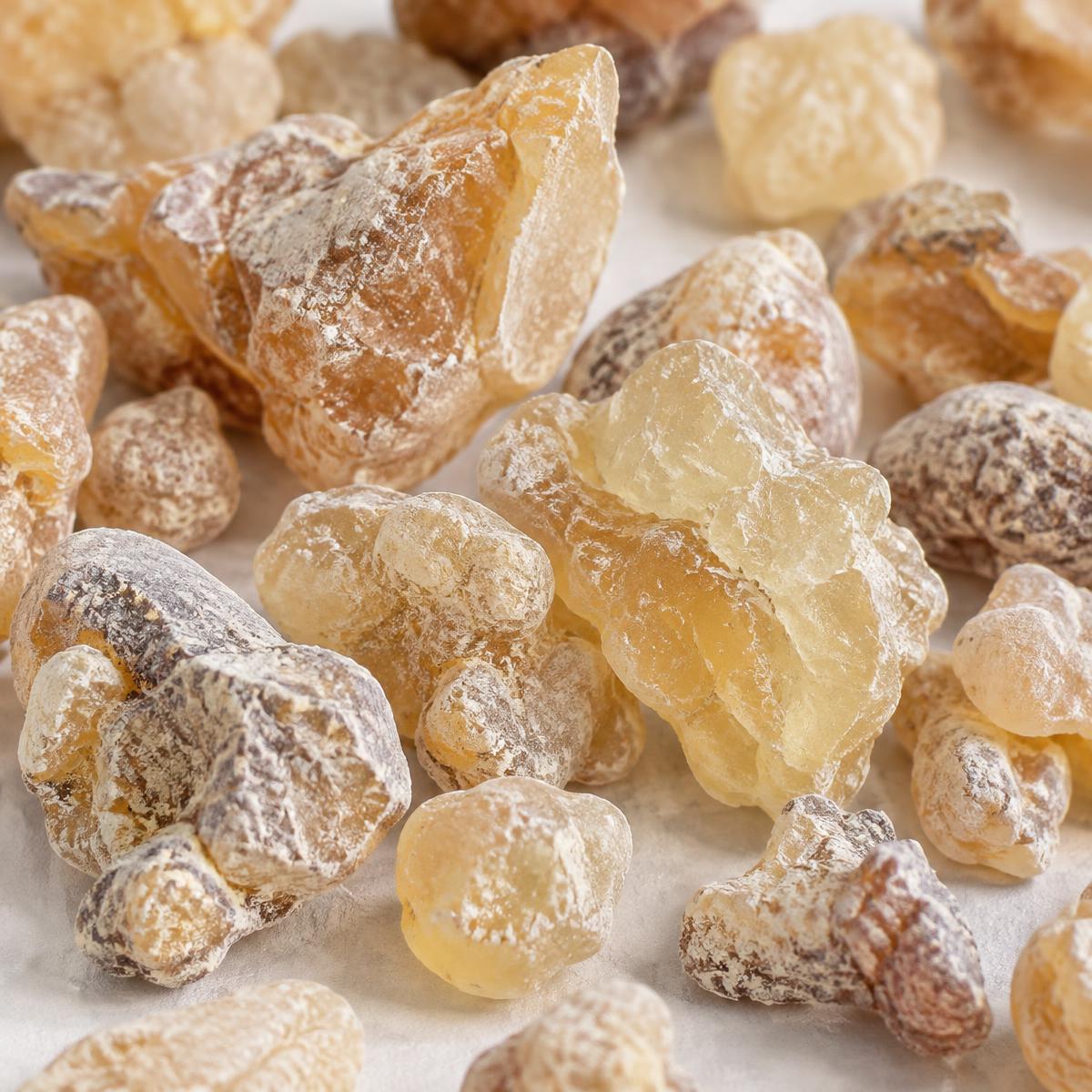
A distinctive chemistry: Boswellia frereana resin, naturally rich in lupeol, α-amyrin, β-amyrin, 3-epi-lupeol and α-pinene

01

Maydi follows its own chemical pathway.

In 2021, resin collected from individual Boswellia frereana trees was analysed compound by compound. The triterpenoid fraction was dominated by lupeol at 14.7–32.5%, α-amyrin at 13.0–25.2%, 3-epi-lupeol at 6.4–14.2% and β-amyrin at 5.3–8.0%. The essential oil showed a variable chemotype characterised by α-thujene and α-pinene — a triterpenoid and volatile signature specific to the species.

An earlier analytical study, published in 2005, had already reached the same conclusion from a different direction. Working by headspace SPME and GC–MS across a range of olibanum samples, the authors found that Boswellia frereana carried its own distinguishable terpenic fingerprint, marked by an abundance of α-phellandrene dimers.

Together the two studies establish a measurable chemical identity for Boswellia frereana, and that identity is what the rest of the research investigates.

02

GABA, calm and the chemistry of Maydi.

The studies below examine individual compounds found in Maydi.

Several compounds present in Maydi have been studied independently for effects on the nervous system. α-Pinene has been shown experimentally to act at the GABAA-benzodiazepine receptor and to prolong GABAergic inhibitory signalling. Separate mouse research reported anxiolytic-like activity following repeated α-pinene inhalation. α- and β-amyrin have likewise shown anxiolytic-like activity in animal models, with experiments implicating benzodiazepine-type receptor mechanisms. β-Amyrin has separately been shown to enhance GABAergic neurotransmission and increase brain GABA levels in a mouse sleep model.

Together, these findings provide a mechanistic scientific rationale for investigating Maydi’s traditional association with calm, mental state and oral use.

  • α-Pinene, a Major Constituent of Pine Tree Oils, Enhances Non-Rapid Eye Movement Sleep in Mice through GABAA-benzodiazepine Receptors

    Molecular Pharmacology · 2016

    PMID 27573669DOI 10.1124/mol.116.105080

    Read paper ↗
  • Daily inhalation of α-pinene in mice: effects on behavior and organ accumulation

    Phytotherapy Research · 2014

    PMID 25340185DOI 10.1002/ptr.5105

    Read paper ↗
  • A possible mechanism for anxiolytic and antidepressant effects of alpha- and beta-amyrin from Protium heptaphyllum (Aubl.) March.

    Pharmacology Biochemistry and Behavior · 2007

    PMID 17207523DOI 10.1016/j.pbb.2006.11.019

    Read paper ↗
  • Positive effects of β-amyrin on pentobarbital-induced sleep in mice via GABAergic neurotransmitter system.

    Behavioural Brain Research · 2015

    PMID 26026786DOI 10.1016/j.bbr.2015.05.005

    Read paper ↗

03

Cartilage and inflammatory signalling.

In 2010, researchers took Boswellia frereana extract into an in-vitro cartilage-degradation model, testing it against cytokine-stimulated articular cartilage. They reported inhibition of collagenous-matrix breakdown, reduced expression of the matrix metalloproteinases MMP9 and MMP13, and reduced production of inflammatory mediators including nitrite, PGE2 and COX-2.

The paper also named the principal constituent of the extract: epi-lupeol. That is the same triterpenoid chemistry the compositional studies describe, appearing again in a functional experiment.

  • Boswellia frereana (frankincense) suppresses cytokine-induced matrix metalloproteinase expression and production of pro-inflammatory molecules in articular cartilage

    Phytotherapy Research · 2010

    PMID 19943332DOI 10.1002/ptr.3055

    Read paper ↗

04

Cell migration, invasion and c-Met.

A 2018 study applied traditional Somali Boswellia frereana extract to triple-negative breast-cancer cell models and examined how the cells behaved when stimulated with HGF. The extract suppressed HGF-enhanced migration, adhesion and invasion/tubule formation, and the authors reported reduced phosphorylation of the c-Met receptor — the signalling step through which HGF drives that behaviour.

This is laboratory cell-line work on the underlying signalling, and one of the dedicated studies conducted on Somali Maydi material.

  • Boswellia frereana suppresses HGF-mediated breast cancer cell invasion and migration through inhibition of c-Met signalling

    Journal of Translational Medicine · 2018

    PMID 30314527DOI 10.1186/s12967-018-1660-y

    Read paper ↗

05

Broader comparative research

Boswellia frereana also appears in wider comparative work. A 2026 study examined a range of Burseraceae extracts, Boswellia frereana among them, in human airway-cell inflammatory models covering viral and chronic respiratory inflammation, and reported comparative anti-inflammatory activity across the tested extracts. It provides broader comparative context across the genus.

  • Anti-inflammatory properties of Boswellia frereana Birdw., Boswellia neglecta S.Moore, Boswellia rivae Engl., Boswellia sacra Flück., Boswellia serrata Roxb., Commiphora confusa Vollesen, Commiphora kataf (Forssk.) Engl. and Commiphora myrrha (T.Nees) Engl. extracts in viral and chronic respiratory inflammation.

    Journal of Ethnopharmacology · 2026

    PMID 40876795DOI 10.1016/j.jep.2025.120500

    Read paper ↗

Research on this page covers extracts, individual compounds, laboratory and animal models; findings apply to the study materials and models described in each paper.

Open jar of Maydi resin with the silver lid resting beside it

Somali Maydi Frankincense

Boswellia frereana · 50 ml

299 kr / €29

Natural Boswellia frereana resin from Somalia.

Maydi · 50 ml · 299 kr

Buy Maydi